Researching and Re Creating Ancient Pre Contact Deer and Elk Hide Native American Clothing with every step Researched and Documented.
Showing posts with label B. One Hide Off The Shoulder Dress. Show all posts
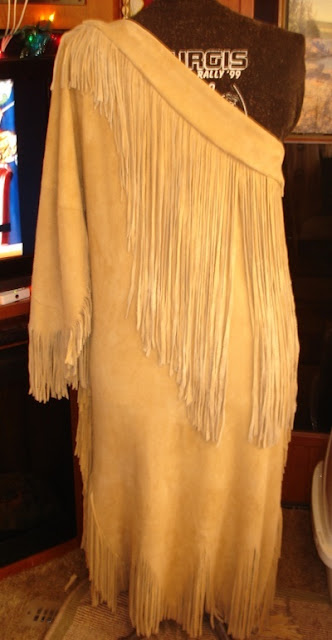
Eastern Wampanoag Style One Shoulder Two Hide Dress
![]() |
| Front of Dress |
I also constructed it from modern leather as there were so many problems I had to work out, I wasn't going to use good Brain Tan on what was mostly an experiment and could have very well have failed in the execution.
I started this dress before attempting Sheila's and I am very surprised how nice it came out. I got a bit carried away with the fringe but it was there, so I cut it, thinking I could always trim it down later if I like. (The blue strap T shirt on the form has nothing to do with the dress, I use it to hold the cover in place and give me a more pinnable surface). I also left the skirt a little longer and the fringe a bit shorter, I like a little more coverage on the leg.
This garment, I feel, at least in construction, if not style, better reflects the day to day wear of the Native Peoples of the East Coast. Of Course, they may have worn it with one breast exposed, but today's conventions require a bit more modesty if one is to go out in public.
![]() |
| Mia's dress being measured and repaired |
![]() |
| Back of Dress |
![]() |
| Me modelling Mia's dress after repairs |
The dress was assembled using artificial sinew and a simple welted seam up each side using a Tandy sewing awl, as this was how Mia's Dress was constructed.
I left the shoulder fold over on and stitched it up to create a short sleeve, this is what was on Mia's dress originally, but had been cut off before it ever came to her. Hers had also been changed by adding a button closure at the top of the fold over sleeve at one point.
This is one of those projects that only took a coupe days and was made because I had the hide laying around and could see that it needed to be this dress. I didn't have enough leather to make a sleeve or cape for the other arm, but have a lovely white fox stole that should compliment the leather quite nicely. I imagine I will sew on seed beads or pearls when I get the chance...
![]() |
| Left Side |
![]() |
| Right Side |
Dancing The One Shoulder Dress
Finally, Sheila's dress is essentially done and gets to wear her dress at the Mt. Dora Powwow in Florida.
Here she is with the shawl removed and tied at the waist.
Every once in a while you meet someone like Sheila, who is just as excited about your projects as you are.
She will take you call at early morn or late at night when you are bone tired and finger sore, frustrated beyond all hope of ever finishing what you have begun.
Just when you are ready to throw in the towel, she calls and has found just what you need, or had found someone to help in the project.
She never lets you quit or backslide, she is always holding the hot iron to your feet.
I look forward to many more years of research with my lovely friend, we already have at least three more dresses to make, a Native Girdle, (belt), a Headdress or two and we want to goof around with a fiber set of shoes too.
What a Gal, what a friend.
Here she is getting ready to take part in the "Round Dance", (Sheila was so excited, she forgot her moccasins, but she looks so good in her new dress, no one will even notice!
This was a great project that I enjoyed more than I can say.
Sheila has been my inspiration and support as I have plodded my way through tons of historical documentation looking for the Sauratown dress, and others).
When I was lost or confused or just plain fed up with the lack of information, or if my path was blocked with paperwork, she pushed me on encouraged my endeavors
Although the true Sauratown dress was probably a great deal more brief in design and function, Sheila wanted this dress made this way to fit her dream and since I wouldn't ever say no to her wishes after all she has done for me!
As you can see below, this dress surely can dance and did!
![]() |
| This dress can dance! |
Later we will be adding shell bead work and a headdress, but for now at least, she gets to enjoy the fruits of our labors.
Now, on to finishing my Elk Two Hide Dress!
Fringing and Finishing The Dress
After marking the boundary edges with masking tape, I cut fringe for about three days.
Sheila really wanted the "dagget" look on the hem, so it was easily marked and added.
Later a row of shell beads will accent this hem, following the triangles.
Here it is, all fringed, Sheila chose not to cut the fringe short, but leave as much of the hide intact as possible.
The upper edge was given a fold over look by tucking the fringe edge up and under.
A strap was added under the fold that wraps under the arm and crosses under the folded edge at the upper shoulder. This gives a little extra hold for the bust edge at the armpit. It can be tied, but is currently just pinned because someone needed to get out and dance.....isn't all our regalia held together with pins anyway? Be truthful now! Honestly, the most valuable person at the Powwow is a person with a pocket full of safety pins!
Here is the dress with the cape over one shoulder, acting as the separate sleeve.
I added another strip of fringe to the fold over edge of the cape to balance out the collar.
And now... to the dance!
Rethinking The Sauratown Dress, a Moment of Clarity
I love being wrong. Especially when I find out the truth and have a chance to straighten out the record and share that new found knowledge with others.
Something about the dress I was creating really began to bother me. It wasn't like the Sioux to change their clothing to that of others in their region. They were a clannish, tightly woven group separated from all of the tribes around them by language and belief.
It just wasn't like the Siouan Peoples to move into an area and adopt the clothing of the peoples around them, anymore than they would adopt their language and customs. It was well proven that they loved to trade with others, but they adhered to a strict set of beliefs that included their manner of dress.
The
dress of the Tribes around them was a loose fitting large hide
averaging two yards long by one yard deep that was wrapped around the
body and tied at the shoulder, leaving the sides open, (except when tied
at the waist), and often dropped off the shoulder to be worn as an
apron revealing one, or both breasts and often the backside as well. This suited their lifestyle well and was probably their garment of choice for hundreds, if not thousands of years.
When it came to the Sioux and their style of dress they already had a garment in their past Canadian history that would suit just fine. While living in the Canadian wilderness they wore a one hide side fold
dress that joined at the shoulders. At that time they had separate
detachable sleeves and leggings, also a hooded coat.
They employed a type of sewing used to hold these dresses together,
careful, small, welted, whip stitched seams were the hallmark of the of
Canadian Northeastern tribes because they needed to keep the cold wind
out and provide a solid, stable outfit. In no other area of the Western
Hemisphere do we find this type of sewing, especially in the South where
clothing was casual and loosely knotted at the shoulder or cinched at
the waist.
Their Women were also the very model of modest people from the North,
who would perhaps be less likely to go bare breasted at any time, (as the one shoulder dress reqired), since
it was not in their hereditary past, as would a Southern Tribal member to whom going naked was a hereditary way of life.
In terms of Native American History, Clark Wissler, Author of the "Anthropological Papers of the American Museum of Natural History, Vol. XVll, Part ll 1915"
made an extensive study of the evolution of the everyday wear of Pre
Contact Aboriginal peoples of this continent. If you want to read
this very important work you can download the PDF Here.
According
to his studies, the Two Hide Sioux Plains dress came about once tribes moved from East, (where they practiced and agrarian lifestyle), to West and began hunting buffalo and living a Hunter/Gatherer style of life. Freed from agricultural chores and such duties as pot making and permanent home building to follow the abundant and easy to harvest, massive herds Buffalo that had recently overpopulated the Plains provided them with a
relatively affluent lifestyle in which they had more time to make and
prepare more decorative and flowing clothing, ergo the Great Plains Two Hide Dress.
I had always assumed, (as have many before me), that this migration was from the Hudson Bay area to the Northern Plains when evidence is now mounting that the Siouan Peoples first moved into the Eastern States presently called North and South Carolina during the Woodlands period and THEN migrated onto the Great Plains.
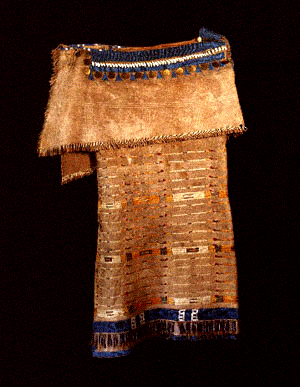
When they moved to the Sultry weathered South they simply removed the accessories they didn't need and had the perfect warm weather dress. Here are two exquisite examples. I want to point out that the text in describing the construction in the first dress agrees with my theory. Please feel free to click on the pictures to magnify them so you can read them easier. They are both post contact, but they reflect a dress that has been in existence for more than 500 years.
How could I prove that this design was the Sauratown Woman's Dress? One dress I had seen in museum collections kept popping into my mind. I searched my archives and came up with the dress below.
This dress was collected from the Sioux in the early 1800's. If one looks very closely at the bead work on the front one can see something in this Yanktown garment that leads us directly to the Sauratown peoples.
The shells decorating the top edge are Marginella Prunum Apicinum, or the Common Atlantic Marginella.
They are miss identified as being Cowrie, which is easy enough to do if you aren't a shell collector, but closer examination shows them to be a shell in common use and normally found in burials in the Carolina's during the Dan River, Woodland and the Early and Late Saratown eras and not a shell used by Plains Women on their Two Hide dresses.
![]() |
| Shells from Sauratown Mounds |
What were these shells from the Florida Estuaries doing on a dress in Yankton, South Dakota in the early 1800's?
Trade? Unlikely. The Plains Sioux used many types of shell in their garments pre contact, mostly dentalium. In all the dresses I have examined, I have never seen this particular shell used on a single Plains Sioux garment, especially not the Two Hide Plains Dress.
The Plains Sioux did make use of the European imported money cowrie Post Contact in place of Elk teeth sometimes, but cowrie used Post Contact are an entirely different family than the marginella which was used for thousands of years before contact. I have never seen marginella used on a Sioux garment until this one.
Then there were the glass pound beads. Most Plains Sioux used the powder, or sky blue type illustrated in the first side fold dress shown above in the first pictures. Yet the side fold dresses shown here have a deeper periwinkle blue more popular with the South Eastern Tribes and included in their mound burials.
Also, the beaded patterns themselves slightly differ from those of the Plains Sioux but have enough of a similarity to firmly place them within tribal bounds.
Is this dress the missing link to what Sauratown Women wore? It could be. You must remember that generally a closed society that refuses to change its language or customs even when the relocated would also retain the rule of only marrying people within their own tribal lines.
This meant that Sauratown brides were exchanged with the Plains Sioux to diversify the blood line without leaving the tribal bounds. Many tribes practiced this and they were very careful to prevent inbreeding by finding other related tribes and traveling to marry off their young people to each other to prevent this through the "Totem" system.
This dress could actually be a Sauratown exchange bride dress. How else would it turn up on the Plains? Local Women weren't interested in wearing a garment such as this, they had already moved onto the Two Hide Plains Dress, while their Southern Siouan Cousins were more strict in their adherence to tribal custom, (not to mention language), and retained the use of a garment that had served them well for over 500 years.
Again, I feel the Sioux Peoples migrated originally from the Eastern shores of Canada, then to the Sauratown area, then to disperse onto the plains. I stand by this assertion because the original style and manner of creating their clothes reflects those found in the colder Northern regions of the country and show a close assembly affinity to Tribal clothing designs found east of Hudson's Bay, such as the Cree, Ojibway and MicMac. I am not alone in this assertion, as the text in the first photo illustrates.
This dress could actually be a Sauratown exchange bride dress. How else would it turn up on the Plains? Local Women weren't interested in wearing a garment such as this, they had already moved onto the Two Hide Plains Dress, while their Southern Siouan Cousins were more strict in their adherence to tribal custom, (not to mention language), and retained the use of a garment that had served them well for over 500 years.
Again, I feel the Sioux Peoples migrated originally from the Eastern shores of Canada, then to the Sauratown area, then to disperse onto the plains. I stand by this assertion because the original style and manner of creating their clothes reflects those found in the colder Northern regions of the country and show a close assembly affinity to Tribal clothing designs found east of Hudson's Bay, such as the Cree, Ojibway and MicMac. I am not alone in this assertion, as the text in the first photo illustrates.
That the Saura Peoples
spoke an ancient form of the Siouan language older than the language
used by the then current Plains Sioux, (at time of European Contact),
leaves us tending to think they moved to the Sara area and then
dispersed to the Plains.
Recent DNA studies seem to bear a Canadian Ice Age origin out, as well as the
oral history of the Siouan Peoples, who even while living in the
Woodlands Sauratown Phase speak of coming originally from the East, but
obviously not from the Carolinas area since they were in residence there at the time of their telling their origination story. Where else could this be and how much
further East can you get on this continent than North Eastern Canada?
The Sioux also tell a story of how Elders warned the young people of the tribe against leaving their cornfields to follow the buffalo. We know they did not grow corn in Canada, but lived a hunter/gatherer lifestyle. So this places them in Sauratown and introduced to corn growing before they left for the plains.
![]() |
| Another example of Sioux Dress |
I think enough evidence exists at the very least to place the Siouan Peoples of Sauratown in the side fold dress. It was an original Sioux Dress, (as these examples clearly point out), and more suitable to the climate than the two hide plains dress.
An excerpt from "The American Anthropologist" Volume 7, Issue 3 reads:
And I quote this: These garments were fastened at the shoulders with leather. they were thrown over one or both shoulders and brought usually under one arm.
This article talks about all the tribes of the Carolina's area and not just the Sauratown people. I feel that since all the tribes around them wore a one shoulder garment that is documented, it leaves the Siouan people wearing the dress attached at Both Shoulders.
Time will bear out my conclusions to be either faulty or truth, but somehow I feel closer to reality placing the Sauratown Woman in this garment than any other.
Now to Create it Sauratown Pre Contact. Coming soon to a Blog near you!
Adding Gussets, Welts and Sewing Side Seams
![]() |
| Gusset eased into place Right side o |
The
most important part of placing the gusset is to get the bottom where
you want it then ease it in up the dress until it sits flush and
unwrinkled.
Then
you turn the dress inside out and place right sides of the gusset and
body together with pins on both sides of the dress, checking to see that
the dress has not become distorted before placing the welts between the
seams and re pinning.
Then
you carefully unpin one pin at a time and wedge the "Welts to be
fringed" between the gusset and side seam facing each welt right side to
right side with the dress body proper. So your layers are, Gusset edge,
welt edge, dress side edge, in that order.
The Two Hide Dress was also a Siouan Garment and I feel the assembly would have been the same, as they were remarkable and cleaver seamstresses who would have plied their exceptional talents in the East, as well as the Great Plains.
You want to make sure your welts are symmetrical from side to side, (although you can adjust this late by trimming).
Now
step back and check to make sure your dress is square and true, that
one side flares and drapes as nicely as the other before sewing. Measure
from the floor to the bottom of your gusset, nothing is worse than
having your gussets knock the entire shape of the dress off.
![]() |
| Inside out, gusset and welts pinned in place |
This
is a good time to make a sharp critical inspection of the dress and
placement of the welts by peaking under the dress and making sure they
are matched and hanging straight, also I make sure the welts are right
side facing right side of the dress for a "finished" look. (You can turn
the dress right side out to check this, but it can upset your pinning, I
do it by crawling up under the dress on the dress form and looking
around, or gently turning up the edge of the skirt).
![]() |
| How the gusset meets at the top |
Here
I show the top of the gusset where the two sides of the gusset meet,
showing three layers on each side of the gusset, namely, left side of
gusset, welt sandwiched in between and right side of gusset.
The
next picture shows me sewing a whip stitch with real sinew close to the
raw edge just far enough in to get a firm bite of each layer...
![]() |
| Gusset sewn and pulled flat |
The side seams are sewn by starting at the top of the dress at the armpit area on both the left and right after cutting the left sleeve away from the body of the dress. The left side armpit is cut by extending the sleeve out and cutting flush up the pinned side seam to the area of the armpit, stopping at six inches below the pit or just at where the top of the girdle, (belt), will ride. Sew down the side using the whip stitch shown, leaving the fold over seam area at the right armpit open for now, as well as the bottom of the sleeve on the left to be finished after the rest of the garment is assembled.
Here is the dress turned right side out and rehung on the form. You can see the fringe welts on either side that will be cut later.
I have also whip stitched a additional swath of leather to the sleeve to make it Siouan full length and to fill in where the leather was lacking on the sleeve end.
The Shoulder seam is sewn using the welt seam method starting at the neckline and sewing down the top of the arm seam.
I have also whip stitched a additional swath of leather to the sleeve to make it Siouan full length and to fill in where the leather was lacking on the sleeve end.
The Shoulder seam is sewn using the welt seam method starting at the neckline and sewing down the top of the arm seam.
I then
added my welts between the layers..and whip stitched all together, then
turned, flattened the seam and trimmed the welt to be flush.
The
leather across the top is very thick and spongy, very hard to sew
easily. This also creates a stiff yoke that adds structure to the dress
line itself, but is a total pain to sew and forces you to sew a thicker
seam to penetrate to the stable leather.
This
will be important once beads and or shell is added, the
shoulders must support a great deal of weight without shifting or
pulling, but makes the shoulder seam heavy and bulky. Trimming the welt
close helps to ease this bulk as well as using an equally thick and
spongy welt.
I
always match my welt thickness to the leather on the seams, this
creates a uniformity of tension and weight that is noticeable. You must
always be certain to have your seams very straight, or pucker and sway
will translate into a ghastly bulge or swoop when done.
I feel this garment is a good compromise between the Eastern one shoulder dress and what we have documented about the Sioux way of assembling garments. The dress will be longer than Eastern styles and feature a full sleeve on the left reflecting a Matron Elders way of dressing and obviously Fall or Winter Wear. It is being assembled using the Plains Sioux way of finishing seams.
One must also keep in mind with this garment that it is being constructed under the direction of the person who will be wearing it, so it has elements that are slightly different than what I would consider the average, or optimal representation of garments this period.
I have created, in the meantime, a garment that more closely resembles the shape and form of average daily wear of this period and will post this dress and info in my next post. I am also making Sheila a lighter, shorter version of this same dress that I will be showcasing later on.
I would also like to say at this point that the use of the terms "Siouan" and "Sioux" are terms used by researchers from the time of first studies in the early 1800's. I am well aware that these are not the genuine names of the people represented, but names in common use by researchers at the time. Proper names for tribes and peoples are out there, but I retain the use of these archaic terms to make researching for others easier. I in no way intend to offend any peoples by my use of these terms.
I feel this garment is a good compromise between the Eastern one shoulder dress and what we have documented about the Sioux way of assembling garments. The dress will be longer than Eastern styles and feature a full sleeve on the left reflecting a Matron Elders way of dressing and obviously Fall or Winter Wear. It is being assembled using the Plains Sioux way of finishing seams.
One must also keep in mind with this garment that it is being constructed under the direction of the person who will be wearing it, so it has elements that are slightly different than what I would consider the average, or optimal representation of garments this period.
I have created, in the meantime, a garment that more closely resembles the shape and form of average daily wear of this period and will post this dress and info in my next post. I am also making Sheila a lighter, shorter version of this same dress that I will be showcasing later on.
I would also like to say at this point that the use of the terms "Siouan" and "Sioux" are terms used by researchers from the time of first studies in the early 1800's. I am well aware that these are not the genuine names of the people represented, but names in common use by researchers at the time. Proper names for tribes and peoples are out there, but I retain the use of these archaic terms to make researching for others easier. I in no way intend to offend any peoples by my use of these terms.
One Shoulder Dress a Proper Hanging and Trial Fit
To start this project out right, the hides are first hung, (head down as Siouan tradition dictates), on the form as you would for a two hide dress. This means you do not just hang one shoulder and sling under the arm and attach. This would cause the hides to hang crooked once they are on the person who is going to wear it. (I see this mistake made with this type of garment constantly!) The hides are folded over about four inches at the shoulder so the hides hang nicely and provide a stabilization by doubling the thickness at the shoulder, neckline area.
We left the hides full length at this time, trimming just so it did not drag on the ground, (having adjusted the form to the actual height of the wearer). This is done so that length can be determined when the dress if done and fully fitted.
Hang the hide with both shoulders attached and let hang overnight to see if they are hanging straight, with no unsightly bulges or sways.
Then pin sides by smoothing the hide down and across the form and securing to the form at the dividing line. (Pinning to the form first keeps the front hide from pulling the back hide and vice-versa, preventing the garment from twisting on the form).
Then you can pin sides to each other, (keeping the form pins in place in case you have to adjust the flow of the hides later), up to about six inches under the under arm, or where you want the top of the bust line to fall. (this dress was worn with the breast exposed originally, but modern times dictate we cover).
This dress should fit the form quite tightly, just enough to be able to slide it off without removing pins. By doing so, you create a sort of fit that helps support the bust without undergarments. (One can try to wear a type of bra or girdle underneath, but it will be difficult and will most likely show).
Then carefully unpin the top right shoulder and let it fall down as in the picture on the right.
The dress will now be true and square at the hem when worn instead of swaying off to the side as it would if you did not secure the garment by pinning the sides before you drop the shoulder.
After this you can remove the pins tuck in the form, keeping the seam down the dividing line of the form, (the median). Pin very securely, especially at the armpit and shoulder, you are about to slide the dress of the form for a trial fit.
Summon the future wearer of the garment and have them wear a fitting,
thin cover-up that does not change or bind their natural shape. if they
will not be wearing a bra, have them remove it at this time.
Before trying on, secure the shoulder and armpit with industrial strength safety pins. After the garment has been slipped on, use a second set to safety pins to readjust the fit around the bust so nothing is revealed or spilling out, leaving the original safety pins in place so you have a median starting point as you adjust.
Have your subject go outside and wander around, walking, bending and lifting the arms as you observe how the garment moves, making note of corrections where the dress is binding or bulging.
First and foremost, this is supposed to be a comfortable garment, it should not pinch or twist at any point. It should flow from top to bottom smoothly and gracefully.
The wearer should feel at ease and comfortable, as this photo shows, Sheila is really enjoying her trial fit, even though it is bristling with pins!
This photo shows a potential problem, the hides are thinner at the bottom being hung head down, so we will have to place a gusset on the side to allow the skirt to flow without binding, this is easily accomplished as welts to be cut into fringe will be inserted in the seam anyway and the gusset can be added at this time.
If we were to leave the sides open, as some younger women did, it would not be an issue, but our garment must cover, as it will be worn in teaching situations.
Also, this garment must reflect Siouan ways of assemblage, which was a longer, more flowing skirt and a gusset would allow more freedom of movement, as was often done by Siouan Peoples.
Have your model sit and move around in a chair. Again, this insures a comfortable fit and shows potential bulges and sways that will impact the overall look.
Remember, our theory from the beginning, (and has been borne out through research), was that women did not just throw a garment on the ground, cut it and sew up the sides, (as has been suggested by otherwise well researched literature), clothes were made to fit the potential wearer by fitting the garment on the actual person to whom it would belong.
We use a dress form, but in actuality women stood as models and had the garment tediously fitted to them. This is a fact that I have seen in museum garments.
So far so good as far as this dress goes, doing a proper setup on the form and carefully fitting the garment properly has paid off in a good fit, which will save much agony and regret further down the road.
Also seeing your subject happy and comfortable in her future dress is the greatest reward a seamstress can have!
What Native American Women Wore - Pre Contact: Off The Shoulder One Hide Dress
The Off the Shoulder One Hide Dress is the original aboriginal garment in terms of Native American History, Clark Wissler, Author of the "Anthropological Papers of the American Museum of Natural History, Vol. XVll, Part ll 1915" made an extensive study of the evolution of the everyday wear of Pre Contact Aboriginal peoples of this continent. It's creation dates back more than three thousand years, so it's not exactly the latest fashion but is an important part of Native American History! If you want to read this very important work you can download the PDF Here.
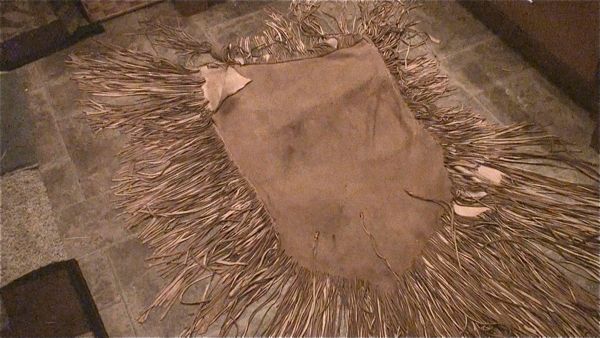
After discovering and restoring Mia's Two Hide off the Shoulder Dress, I had more questions than answers. I found this site Plimoth Plantation Wampaoag Site that gave me a great deal of comfort about the decisions I had made when correcting Mia's dress alterations.I was indeed correct in the assumption that a strap ran through the upper portion of the fold over and that it was tied with this strap. The dresses shown in the pictures from the Plimoth site were indeed one hide dresses, wrapped around and fringed on the one side, but two hides were also commonly used when larger hides could not be found.
The following illustrations and paintings show the various ways this garment was worn by early Men and Women.
The dress was worn tied at the shoulder, or in more temperate weather was simply hung at the waist by a belt creating a skirt effect.
In colder weather the dress was topped with a cape of fur or hide over the bare shoulder and I have found some suggestions that a sleeve was created and attached to the bare arm that draped across the back and tied at the shoulder tie area.
Tribes that wore this garment include:
The dress was worn tied at the shoulder, or in more temperate weather was simply hung at the waist by a belt creating a skirt effect.
In colder weather the dress was topped with a cape of fur or hide over the bare shoulder and I have found some suggestions that a sleeve was created and attached to the bare arm that draped across the back and tied at the shoulder tie area.Tribes that wore this garment include:
Powhatan
Iroquois
But this list is not all inclusive, and at one time, just about everyone, everywhere, (including our European Ancestors), wore this type of garment.
Subscribe to:
Posts (Atom)