Showing posts with label D. Side Fold One Hide Dress. Show all posts

Dancing The One Shoulder Dress

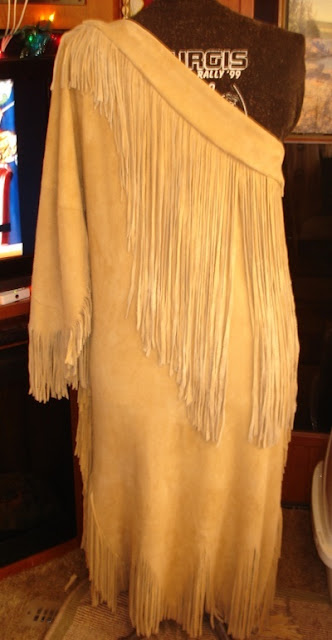
Finally, Sheila's dress is essentially done and gets to wear her dress at the Mt. Dora Powwow in Florida.

Here she is with the shawl removed and tied at the waist.

Every once in a while you meet someone like Sheila, who is just as excited about your projects as you are.

She will take you call at early morn or late at night when you are bone tired and finger sore, frustrated beyond all hope of ever finishing what you have begun.

Just when you are ready to throw in the towel, she calls and has found just what you need, or had found someone to help in the project.

She never lets you quit or backslide, she is always holding the hot iron to your feet.

I look forward to many more years of research with my lovely friend, we already have at least three more dresses to make, a Native Girdle, (belt), a Headdress or two and we want to goof around with a fiber set of shoes too.

What a Gal, what a friend.
Here she is getting ready to take part in the "Round Dance", (Sheila was so excited, she forgot her moccasins, but she looks so good in her new dress, no one will even notice!

This was a great project that I enjoyed more than I can say.

Sheila has been my inspiration and support as I have plodded my way through tons of historical documentation looking for the Sauratown dress, and others).

When I was lost or confused or just plain fed up with the lack of information, or if my path was blocked with paperwork, she pushed me on encouraged my endeavors

Although the true Sauratown dress was probably a great deal more brief in design and function, Sheila wanted this dress made this way to fit her dream and since I wouldn't ever say no to her wishes after all she has done for me!

As you can see below, this dress surely can dance and did!
This dress can dance!
Later we will be adding shell bead work and a headdress, but for now at least, she gets to enjoy the fruits of our labors.

Now, on to finishing my Elk Two Hide Dress!

Fringing and Finishing The Dress

 After marking the boundary edges with masking tape, I cut fringe for about three days.

Sheila really wanted the "dagget" look on the hem, so it was easily marked and added.

Later a row of shell beads will accent this hem, following the triangles.


Here it is, all fringed, Sheila chose not to cut the fringe short, but leave as much of the hide intact as possible.

The upper edge was given a fold over look by tucking the fringe edge up and under.

A strap was added under the fold that wraps under the arm and crosses under the folded edge at the upper shoulder. This gives a little extra hold for the bust edge at the armpit. It can be tied, but is currently just pinned because someone needed to get out and dance.....isn't all our regalia held together with pins anyway? Be truthful now! Honestly, the most valuable person at the Powwow is a person with a pocket full of safety pins!


Here is the dress with the cape over one shoulder, acting as the separate sleeve.

I added another strip of fringe to the fold over edge of the cape to balance out the collar.

And now... to the dance!

What Native American Women Wore - Pre Contact: Side Fold One Hide Dress


The True Side fold dress is always a one hide dress wrapped around the body with an armhole cut in the folded side and the side seam left open on the seam side to accommodate the arm.

Many Off The Shoulder dresses are wrongly categorized as side fold dresses as the construction is very similar, the difference being the hole obviously cut on the fold side to allow the arm through.

These dresses were popular on and off through history in between the Off The Shoulder and Strap Dress Era. They obviously were limited to those tribes who had access to very large hides such as Elk and Buffalo.

No evidence of detachable sleeves or leggings are present.

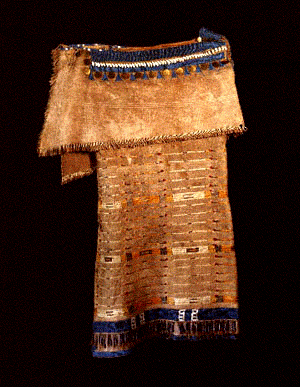
Catalogue Description of the dress above: This side fold dress consists of six pieces: the main body of the dress, the flounce, the shoulder flap, the top bodice, and two hide things as a second shoulder strap. The horizontal seam is low and the folded over portion is shorter and would barely cover the breast. The folded over flap is even shorter in the back. The hide is worked so that the flesh side of the skin lies against the wearer, with the fur side out. The flounce is laced with hide thong. The seam of the dress, the blue and white pony beads on the shoulder strap, and the hem tabs are all sewn. It is likely that the two bottom tabs at the left side of the dress are formed from a remnant of the foreleg of the animal or are a decorative form to resemble this pattern technique. Ten quilled stripes are worked around the skirt of the dress, horizontally, in measured registers of blue (once blue-green but faded since original BMA acquisition) and brown quill, separated by shorter sections of white porcupine quill where red tufts, once the tassels, of yarn emerge. Small black lines separate each quilled section. Some vertical marks of what is probably ochre appear at the ends of the quilled bands. Tin cones and a few copper cones are sewn to the bottom of the flounce, more or less at knee length, and on the two bottom tabs, which are further elaborated with an edging of blue and white beads. Five pairs of copper cones are sewn up the side seam. If the shoulder strap is examined from above, blue and white beads can be seen ornamenting the seams. A single row or blue beads edges the sides while the front and back seams display eight bands of two rows of white beads alternating with two rows of blue pony beads. See Jarvis supplemental file in Arts of Americas office. 


The side-fold style seems to have been worn by Dakota, Lakota, and Cree women, and possibly also by Cheyenne and Assiniboin women. Lewis and Clark are known to have encountered a party of Cree at Fort Mandan during November of 1804. This two-hide dress has been impressed and painted with red and dark brown pigment, a decorative convention among some Cree groups. However, it is also possible that this dress was made by a woman from the Upper Missouri area.

Indigo and blue-green beaded discs adorn the yoke and a beaded strip has been added to the skirt. The hem is tabbed and the skirt fringe was originally wrapped with dyed orange quills.


Woman's Side Fold Dress
Central Plains/Upper Missouri River (Sioux or Cheyenne?)
Large mammal hide (elk?), horse hair, porcupine quills, bird quills, unidentified plant fiber, glass beads, brass buttons, cowry shells (Cyprea montea), tin-plated tinklers, red wool, pigments, glue sizing, woven wool tape.


This elaborate two-piece, side-fold dress (see previous object, catalogue no. 53046) is decorated in part with dyed porcupine quills and cowrie shells, materials having a long history of use in native North America (although these cowrie, an Indo-Pacific species, must have been imported for trade). The brass buttons, red wool, glass beads, cone tinklers, and pigment were trade goods that came into vogue during the eighteenth and nineteenth centuries. The English gilt brass buttons on the yoke, like the metal trade tokens issued by fur trading companies, were popular decorative elements and status markers during the early nineteenth century. Lewis and Clark noted that brass buttons were more highly sought than all other items save beads. George Catlin painted several Lakota women, one the wife of a trader, displaying rows of such brass disks on their dresses. This is a special occasion dress, worn especially for dancing.


The yoke of this dress has been impressed into a geometric pattern and then painted with clear sizing or hoof glue, a decorative treatment of hide practiced by several central Plains groups including the Cheyenne and the Hidatsa. The rows of horizontal quill work punctuated by red wool "tufts," as well as the arrangement of the brass buttons, suggest that this dress may have been made by a Cheyenne, Dakota or Lakota woman.

This may be the dress given to the Peale Museum by the Hutter family in 1828 and described in the Peale ledger as a "Soux squaws dress." Clark also acquired a dress on the expedition that he described as "an Indian dress, such as the Soues women ware [sic] in their dances." He presented that dress to first lady Dolley Madison.
http://140.247.102.177/Lewis_and_Clark/dresslg.html

Inside the Side Fold One Hide Dress- The Details of Construction

I found this article on an obscure Peopody museum site:

Glass Beads
Glass beads were one of the most successful European exports during the Age of Expansion (1600–1850). Women appreciated their ready-made beauty, and a huge demand for glass beads developed in Africa and North America, where they replaced beads that were handmade from bone, shell, and stone. Meriwether Lewis purchased beads of many sizes and colors to use as trade goods on the expedition. However, Lewis and Clark found that Indian people preferred blue and white beads and sometimes rejected other colors. Lewis later told President Jefferson that blue beads were valued as highly as Europeans valued gold, and white beads as highly as silver.

Cowrie Shells
Many cowrie shells were harvested in the Maldive Islands, some 9,000 miles from central North America. African people, many of them slaves, brought cowries to North America, but they were rarely found in the western United States before 1850. These shells may have been imported by the Hudson Bay Company or by another British trade company.

Porcupine Quills

The woman who made this dress covered the surface with rows of dyed porcupine and bird quills. Quillwork is a traditional women’s art practiced from the Eastern Woodlands to the Plains. Working with quills was considered a sacred art in some Plains Indian communities, and the women who did so were members of special societies.


 Metal Tinklers
The side-fold dress was animated by metal tinkler cones attached at the hem, which sounded a rhythmic jingle when the garment moved. Their presence indicates that the dress was used for dancing. At the time of Lewis and Clark, tinklers were often made from scrap metal recycled from other objects. Indian people regarded metal as one of the most prized trade goods.
Wool Trade Cloth
Small bundles of red wool trade cloth accent the rows of quillwork on the skirt of this dress. European wool cloth was an important international commodity during the eighteenth and nineteenth centuries. It was highly sought in North America, both for domestic use and for the Indian trade. French, English, and Spanish politicians and traders supplied Indian people with wool fabric, most of it dyed red or blue.

LinkWithin

Related Posts Plugin for WordPress, Blogger...